
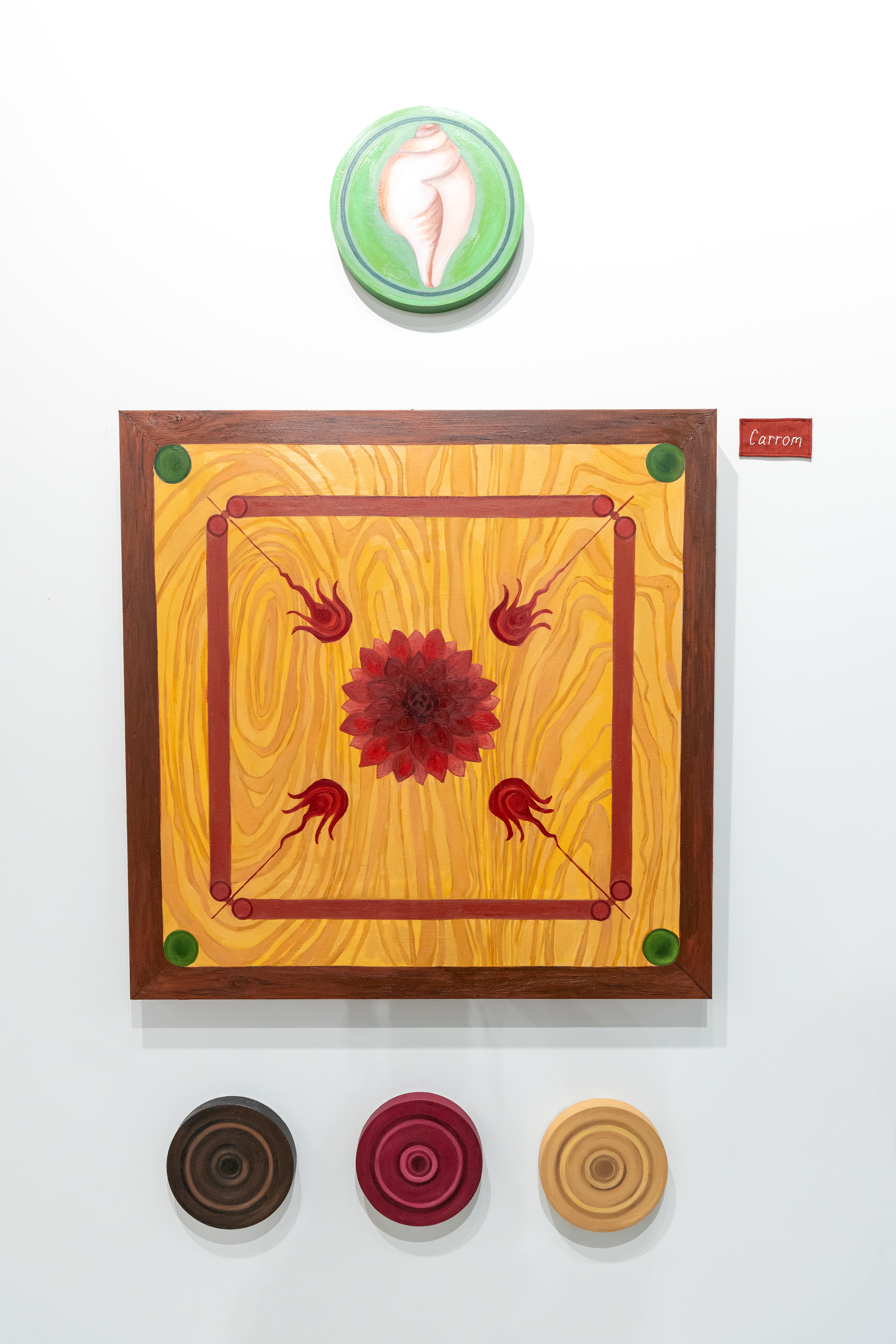
Carrom
Carrom is an Indian board game, similar to Billiards, often played seated on the floor. Instead of a billiard cue, players use their hands in a flicking motion to place the pawns in one of the four pockets in the corners of the board. The red pawn symbolizes the Queen and is the most valuable pawn on the board. This version contains symbols that promote victory: fire (removing all hindrances), lotus (resilience) and the conch shell (prosperity).


Pallanguli (Mancala)
With origins in East Africa, Pallanguli is the Indian variety of Mancala, often played using small natural objects like tamarind seeds, cowrie shells or legumes.

Pagade or Ludo (Pachisi)
This ancient game has many adaptations as it is also known as Ludo, Pachisi, Chaupur and the modern day version of “Sorry!”. Pagade is a game of chance, often played with cowrie shells, with the objective of moving all of one’s pawn to the center or “home”. The center here displays the Om symbol, signifying unity and harmony.

Kaudi Khela (Cowrie Shell Game)
Cowrie shells were used as currency in many cultures. In Indian culture cowrie shells were used as “small money” for small transactions on a daily basis. While they aren’t used as currency in the present day, they are still used in religious dedications for Lakshmi, Goddess of wealth and prosperity. Kaudi Khela is a game of chance. The shells act as dice, with an open faced shell garnering more points than closed.


 chaitra bangalore